
We Connected OpenClaw 🦞 with Instacart ChatGPT App - and Something Awesome Happened
How ChatGPT turned into a payment wallet for our OpenClaw agent — by accident.

We recently ran a small experiment wiring OpenClaw up to agentic commerce, and a hacky little shortcut we tried ended up working way better than we expected. Funny enough, we wrote a post not too long ago about why OpenClaw can’t handle payments well (we’ll recap the argument below), so finding something this scrappy that’s also reliable caught us off guard. Worth sharing.
(Quick context: OpenClaw is an open-source general-purpose AI assistant, and one of the hottest open-source AI projects of 2026.)
Background: Meet Gila
We set up an OpenClaw assistant for our company and named her Gila. She runs locally on a machine in our New York office, and the team interacts with her through Slack by tagging her in the general channel.
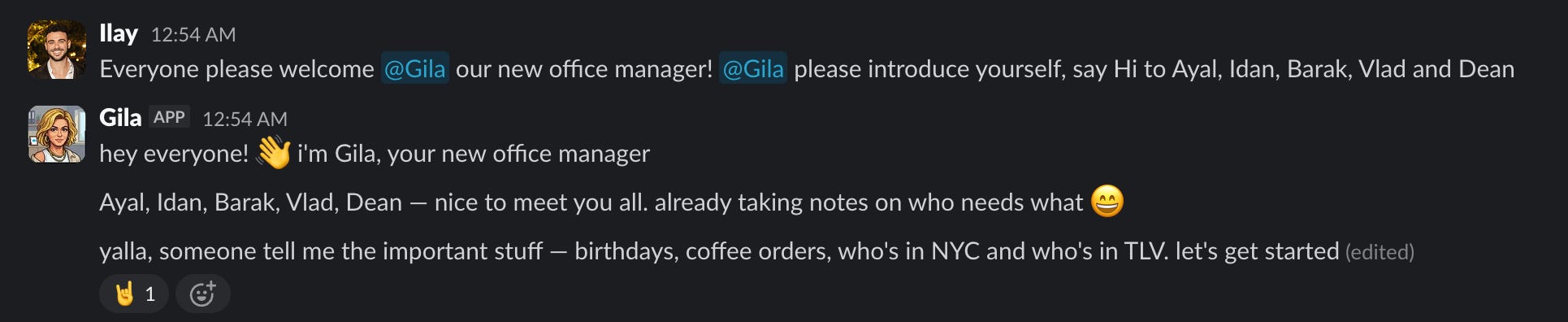
Gila handles lightweight but genuinely useful stuff - remembering teammate birthdays, tracking holidays, running polls, answering company knowledge questions. Anyone on the team can use her.
As an agentic commerce startup, one of the first things we wanted from her was obvious: let her order deliveries.
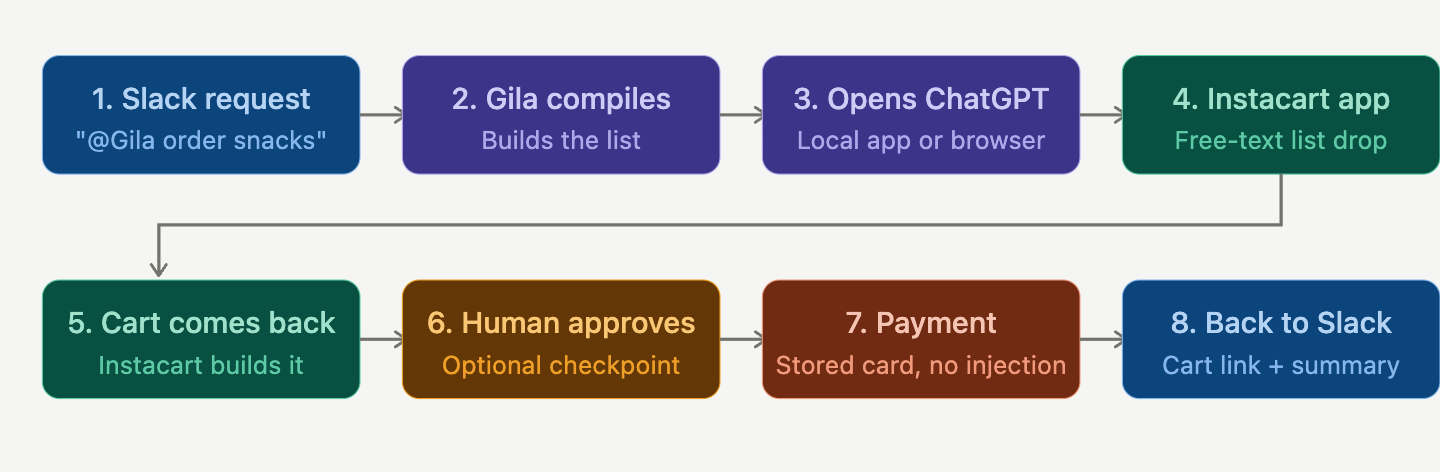
So we wrote a skill.md for office groceries. The spec is simple:
Collect requests from Slack
Compile them into a clean shopping list
Get approval from an authorized person
Use ChatGPT’s Instacart app to build the cart
Post the final cart link and summary back to Slack
Keep persistent notes so future orders get smarter over time
Right now we keep a human-in-the-loop step before final payment, but that’s easy to remove once you trust it (ChatGPT already has our card-on-file and can complete purchases directly in the app).
Instead of rigid integrations, Gila just uses free-form language to talk to a ChatGPT app and get the task done. That shift - from structured integrations to language-driven coordination between apps - is where things started to feel different.
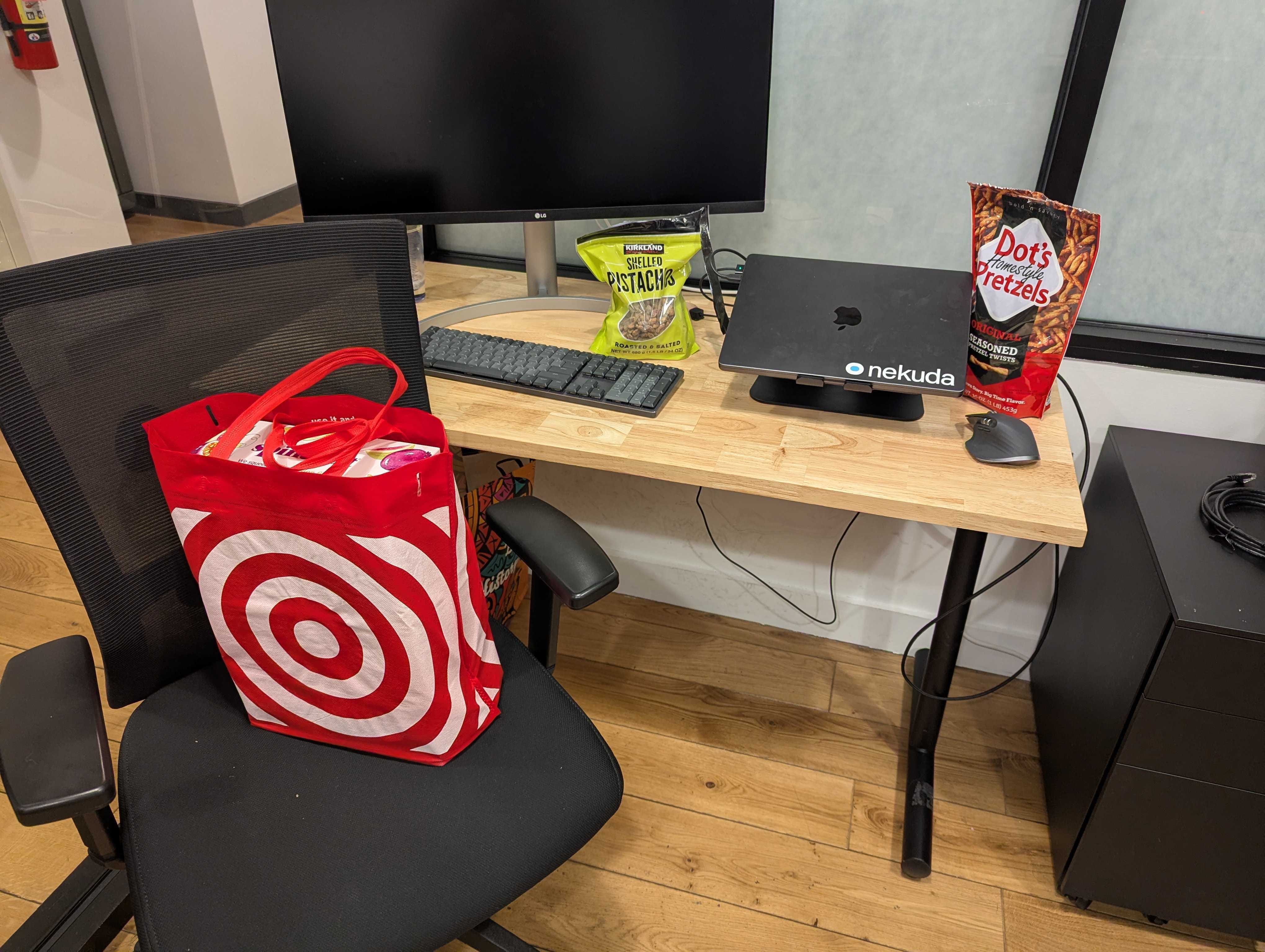
Here is Gila with the fresh groceries she just ordered:
The Key Insight: ChatGPT Apps as MCP Layer + Payment Wallet
The hack is realizing you can treat the ChatGPT Instacart app as both an MCP-style tool interface and a payment wallet.
To appreciate why that’s nice, look at what most agentic checkout demos do today: spin up a browser agent, navigate to the merchant site, manually build a cart, and then either (i) inject payment credentials into the guest checkout flow, or (ii) rely on an authenticated session where the card is already on file.
These flows have more holes than swiss cheese, and hard to see how they scale to consumer-grade experiences. Browser agents are brittle and make constant mistakes, and browser automation is painfully slow - you’re fighting bot protection and fraud detection around checkout, and if that weren’t enough, 2FA flows kill the automation dead.
The ChatGPT apps trick sidesteps all of it, as OpenClaw can open ChatGPT - either in a local app or a browser - use the Instacart app as a wrapper, and drop the requested list in as free text. Because OpenAI already has the card on file, it just pays. That’s it. It’s as elegant as it sounds.
The MCP layer part means structured, text-native tool access. Gila doesn’t click buttons or parse HTML - she describes what she wants in plain text, and the Instacart app handles the rest. “Add 3 packs of Spindrift in different flavors and a coconut water” is a complete, sufficient instruction, which will be injected to the text prompt of ChatGPT local app or webpage (technical note: yes, this is still “browser automation” if you’re running it through the browser - but it’s pretty much almost the only action required to make the whole thing work, so it stays lightweight. Same story if you wire OpenClaw up to a local ChatGPT install and let it use computer-use to click buttons and type text: that’s normally slow and brittle, but the actions you’re asking it to take here are small enough that it doesn’t matter.)
The payment client part closes the picture elegantly. A hard problem in agentic checkout isn’t just product discovery and cart creation - it’s the payment itself. Payment credentials injection is brittle because of browser failures, slowness, tripping fraud signals, 3DS challenges, and issuer friction. And even if the card is on file, many websites object automations and block these behaviors, so that’s a tricky path as well (we’ve mentioned before Amazon suing Perplexity for this type of behavior).
ChatGPT apps route around this entirely - when a user sets up the Instacart integration, they authenticate and store payment credentials inside their ChatGPT account. From then on, the OpenClaw never touches card data - it just orchestrates the session. The payment rails are already there and connected (just to clarify - yes this is a card-on-file scenario, but it lives on ChatGPT and not merchant website, plus it was designed for ChatGPT apps usage. That’s the difference).
As of early today, the ChatGPT app store has around 46 shopping apps and 54 travel apps, with a big wave added in just the last two weeks. A quick sample of what an assistant like Gila could plausibly orchestrate:
Shopping: Walmart, Target, Lowe’s, Instacart, Klarna, Printify, Ticketmaster, Vivid Seats, 1-800-Flowers
Travel: Booking.com, Expedia, Priceline, Uber, Skyscanner, Kiwi.com, Trainline, Turo, GetYourGuide, Viator, Hyatt, Wyndham
(note: not every ChatGPT app supports in-chat checkout yet. Instacart does — that's why this trick works end-to-end for us today. But a lot of the apps in the store are still only offering search and discovery than checkout, and for those you'd still be bouncing out to the merchant to actually complete the transaction.)
Another interesting angle is that some of these apps are already live on Claude as well (Ticketmaster, Target, Booking.com, Expedia, and more). So this trick might work across a few different AI applications.
Caveats
Obviously this only works with ChatGPT/Claude apps that actually exist plus have an embedded checkout, and today that’s a small set - mostly commerce integrations like Instacart. So the surface area is limited.
It’s also worth naming the obvious: this lives in a grey area with the AI app. We’re using a consumer product as infrastructure in a way it wasn’t exactly designed for. It works beautifully today; whether it keeps working depends on decisions of OpenAI and Anthropic.
But the broader point stands - the combination of text-native tool access (i.e., ChatGPT apps MCP based architecture) and pre-authenticated payment turns out to be the right shape for this to work.
This connects to a broader trend in AI right now: a lot of the hacky stuff that ends up working great is basically an accident. Look at Claude Code - nominally a coding agent, but over the last few months millions of people have figured out it’s actually pretty great at productivity, go-to-market work, research, consumer agent workflows, and a dozen other things nobody originally scoped it for. The ChatGPT-apps-as-payment-wallet trick has the same flavor: nobody designed it for this, it just happens to fit.
And sometimes those accidents are the best clue we have about what’s actually working.