
Google Doubles Down on WebMCP at I/O, Amazon Launches Alexa-as-a-Service
Why the Future of Agentic Commerce May Belong to Websites

TL;DR:
At I/O 2026, Google announced moving WebMCP from a prototype into a public origin trial - meaning any website will now officially expose tools to in-browser agents like Gemini, with browser support out of the gate.
Reminder: WebMCP lets your site hand structured tools — search, add to cart, checkout, check order — straight to the AI instead of making it scrape the website, so the website itself effectively becomes the agent interface.
Last week, Amazon launched AWS Agentic Shopping Assistant (ASA) — the tech behind Alexa and Rufus, now packaged for any retailer to build their own on-site assistant.
These two launches are bets on the same future, pulling in opposite directions: retailer-owned assistants bolted onto the site (Amazon’s ASA, and most startups today) vs. WebMCP, where the shopper’s own agent operates your real site. Once you’ve used a WebMCP experience, we think the bolted-on approach starts to feel outdated.
The WebMCP kicker — with WebMCP, users bring their own agent (e.g. Gemini), with a retailer-owned assistant like ASA, the store owns the agent. Gemini works for the user, not the merchant, and that’s why we think experiences will gradually drift toward WebMCP.
🚨 New WebMCP Tools Alert 🚨
To make it easier to explore the emerging WebMCP ecosystem, we’re launching two new tools:
webmcp.cool - A directory of websites that support WebMCP.
Ask nekuda - A Chrome assistant with built-in WebMCP support.
Scroll all the way down for more details or just use the links above.
Google I/O this year was heavily focused on the agentic web and agentic commerce. There are already plenty of good resources covering the announcements (Retailgentic has a good overview of Google’s UCP and Universal Cart announcements), so we decided to focus on a deeper dive into one specific topic: the WebMCP announcements and their connection to another product launch Amazon made last week.
Google and the Agentic Web
Let’s start with a new term you’ve probably been hearing a lot lately: the agentic web. Google has been one of the main companies pushing the concept, and you’ve likely seen phrases like “agent-ready” appearing everywhere.
There is no formal definition, but a simple way to think about the agentic web is:
The agentic web is the restructuring of the web for AI agents across different interaction models - delegation, co-browsing, and fully autonomous flows - and across different activities such as reading, writing, and transacting.
Just as the mobile revolution reshaped the web around smartphones, the agentic web is reshaping it around AI agents that can act on behalf of users. We view agentic commerce as a subset of the agentic web. The two are deeply intertwined, as a large portion of the web today revolves around commercial activities - shopping, travel, financial services, SaaS, and more.
The last two years in AI have largely been about creating new interfaces for consumers. For some use cases, people use ChatGPT instead of a browser to find information or act using MCP Apps. When they use the browser, Gemini is now embedded directly into Chrome, sitting between the user and the website. Google’s AI Mode is becoming a new top-of-funnel experience, replacing search, where users start with AI and only later get routed to a website when needed.
These shifts are changing both the entry point to the internet and the interaction model with online services.
The new interaction models are intermediation, assistance, and co-browsing. The AI helps users with varying degrees of involvement.
This is why Google’s WebMCP announcement is important. It improves one of the core entry points into the agentic web by making it easier for AI systems to interact with web applications and websites.
Google’s WebMCP Announcement
We’ve written a lot about WebMCP before, but here’s a quick refresher - WebMCP is a way for websites to expose tools directly to AI assistants embedded in the browser.
The classic example is Gemini in Chrome. You navigate to a website, and instead of clicking through the interface yourself, you open Gemini and ask it to perform an action. Traditionally, Gemini would have to understand the page by reading and scraping the website. With WebMCP, the website can expose structured tools directly to the AI - things like search, add to cart, checkout, check your order, and more.
Instead of guessing how a website works, the AI can interact through tools provided directly by the website. So the website is becoming an agent of some sort.
What Google has announced at I/O is that they are taking it up a notch, and formally moving WebMCP from a behind-the-flag prototype into a public origin trial starting in Chrome 149. This means that any website can officially implement WebMCP and will be supported by the browser out of the gate (to do this as a website owner you will need a small set up, more instructions from Google are expected to come up this week once it’s live).
Why WebMCP Matters: Preserving the Website in an Agent-First World
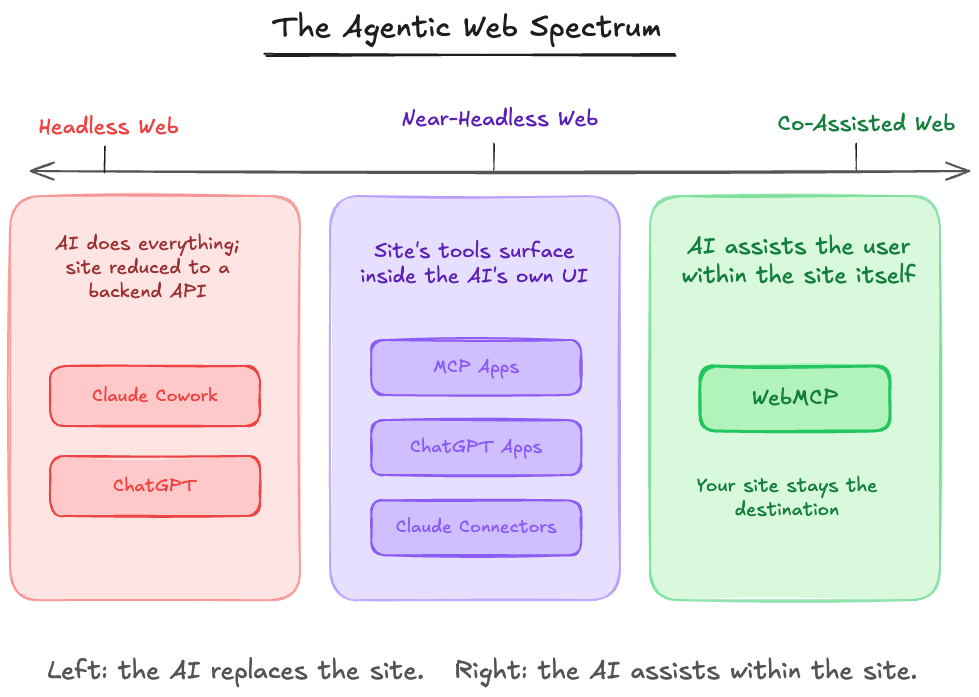
We mentioned earlier that a variety of interaction models are emerging for the agentic web - ChatGPT, AI Mode, browser assistants, and more. One of the biggest themes in agentic commerce over the last year has been the idea of a headless web, where AI agents do everything on behalf of users.
The reality is that most businesses see this as a significant threat. No merchant or internet business in general wants to be reduced to a backend API. No one wants to hand over the checkout flow, customer relationship, and user experience to someone else. We’ve already seen this tension surface in the reactions from merchants to OpenAI’s ACP checkout product.
At the heart of this is a conflict between two visions of the future. On one side is the headless web, where AI intermediates everything. On the other is a co-assisted web, where AI helps users while businesses retain their direct relationship with customers. This tension is rarely discussed openly, but it becomes obvious when speaking with merchants, retailers, and internet businesses.

This is one of the reasons WebMCP is so important. It preserves one of the most valuable assets an internet business has: its website. Instead of building a separate ChatGPT app or hoping an AI platform integrates with your service and surfaces you, you make your existing website agent-ready. A user can arrive through Chrome, open Gemini, and interact with the website in an agentic way while still remaining within the website’s experience.
This is a co-assisted journey, not a headless one. The AI helps the user navigate, discover, and transact, while the website remains a first-class participant in the experience rather than disappearing behind an intermediary.
Now let’s jump to another topic that seems unrelated but is actually is: Amazon announcement about Alexa (formally Rufus).
Amazon Launches Alexa-as-a-Service for Retail
Amazon just launched the technology behind Alexa and Rufus for other retailers that want to build an agent on their own website. The product is called AWS Agentic Shopping Assistant (ASA).
Retailers can now use the software behind Alexa and Rufus to build their own shopping assistant. ASA supports capabilities like intelligent product retrieval and ranking, and natural language product discovery.
This is interesting because the software was built on real commerce usage at incredible scale. In that sense, it is probably the most battle-tested piece of agentic commerce software built so far.
We also found some criticism online, primarily around the potential for AWS vendor lock-in. But the more interesting observation is that we’re starting to see a convergence between how AI assistants have been built so far and where WebMCP is heading.
Alexa-as-a-Service vs. WebMCP
These technologies are coming from different directions, but they appear to be converging toward the same destination. We analyze these by answering two questions -
How is it wired to your site? A bolted-on agent sits in a box on top of your site (an iframe) and reads or calls it from the outside. A native agent operates your actual page through the tools the site hands it directly.
Who owns the agent? A retailer-owned agent (Rufus, Alexa, ASA) works for the store. A user-owned agent — what we call BYOA( Bring Your Own Agent), like Gemini in Chrome — works for the shopper.
How is it wired to your site?
Traditionally, AI assistants on commerce websites have been built as a separate layer that lives in an iframe on top of the website. This is how most shopping assistants work today, including many of the solutions currently being brought to market. WebMCP takes a fundamentally different approach. Instead of adding an assistant on top of the website, it allows the agentic layer to become part of the website itself.
We found an excellent blog post from one of the WebMCP Developer Relations engineers at Google, André Bandar, that dives into this topic in detail (If you’re technical it is really worth the read). The core idea is simple: there are significant structural and user experience advantages to embedding agent capabilities directly into the website through WebMCP rather than running them through a separate iframe layer like Amazon’s version or traditional chatbots/ agents in websites.
If you’ve used assistants like Rufus, you’ve probably felt this. The experience often feels like interacting with a box that happens to sit on top of a website rather than interacting with the website itself. The connection between the assistant and the actual website can feel awkward and disconnected.
We’ve spent a lot of time testing WebMCP-based experiences, and once you see them in action, the difference becomes obvious. The interaction feels more native, more integrated, and significantly smoother (if you want the technical reason, be sure to read André blog).
This is why we think a new competitive dynamic will emerge - on one side are iframe-based assistants, like the approach Amazon is now offering through AWS and many startups are building today. On the other side are WebMCP-based assistants, where the agentic capabilities are built directly into the website.
Who owns the agent?

There is another core difference why WebMCP represents a much better experience: With WebMCP, users can bring their own agent (we call this: BYOA). When a user arrives to a website with Gemini in Chrome, Gemini works for the user, not for the website. Compare that to a retailer-owned assistant, where the interface, incentives, and recommendations are ultimately controlled by the merchant, and will obviously will never say something bad or challenging about the store.
There’s a saying - never ask the barber if you need a haircut. On the same note - never ask Rufus if some product is worth the money. You want the truth? BYOA.
There are good reasons to believe users will prefer assistants that work on their behalf rather than assistants that primarily represent the interests of the website. If that happens, we may see agentic experiences gradually shift away from iframe-based assistants and toward WebMCP-powered interactions.
nekuda WebMCP Directory
We’ve launched two tools to make it easier to explore and build with WebMCP:
webmcp.cool - A directory of websites that support WebMCP. If you’re curious about what’s already out there, it’s a great place to discover and explore WebMCP experiences. If you’ve built a WebMCP-enabled website, feel free to submit it.
Ask nekuda - A Chrome assistant with built-in WebMCP support. The batteries are included, just install the extension (Prerequisites: Go to chrome://flags and enable the "WebMCP for testing" flag in Chrome).
Summary
We are still in the early days of the agentic web, and the emergence of new interfaces for consumer journeys will be one of the most interesting shifts to watch over the next few years. We expect WebMCP to play a significant role in that future, particularly in the co-browsing model of the agentic web, where agents assist users rather than fully replace the website experience. This also better aligns with the trends we are seeing in agent commerce - the need for sovereignty and avoiding disintermediation.
Google moving WebMCP into general availability - which we expect could happen later this summer - will mark an important milestone. For the first time, websites, browsers, and AI assistants will have a common way to work together.
Whether the future ends up being headless, co-assisted, or (most likely) a mix of both, one thing is becoming clear: the web is being rebuilt for agents, and WebMCP is emerging as one of the foundational building blocks.