
Claude Gets Into the Agentic Commerce Race
Three signals from last week that Anthropic isn't just a coding company anymore.

Until recently, there was a pretty strong consensus: Claude is winning the developer race (and a big chunk of enterprise via their API). Claude Code was the best-kept secret in coding for the past year — until it went mainstream a few weeks ago when Anthropic launched a consumer-friendly version called Cowork, and non-coding use cases started blowing up across the internet.
For the uninitiated: Claude Code is a coding agent that lives in your terminal. It helps you write, refactor, debug, and ship code faster. And it wasn’t a marginal improvement - it was a step change. We saw developers go from “I’ll never use this vibe coding tool” to a complete 180. Many of them finally converted this December when Opus 4.5 model came out and broke through every capability barrier.
Anthropic always had a consumer chat app (Claude), like ChatGPT. But their real edge was deeper reasoning + coding workflows that resonated with developers: Opus for heavy reasoning, Sonnet for faster, lighter tasks.
Numbers floating around estimate ~19M MAU for Claude consumer app compared to 900–950M for OpenAI’s ChatGPT. Some speculated that Anthropic had “lost” or given up on the consumer race entirely and that they were all-in on coding and enterprise. And that’s why what happened last week was interesting - we got a few signals that Anthropic is now clearly pushing into consumer and into agentic commerce.
1) The Ads
It started with Anthropic making a strategic product + business statement: Claude conversations will stay ad-free. No sponsored links or advertiser influence on answers.
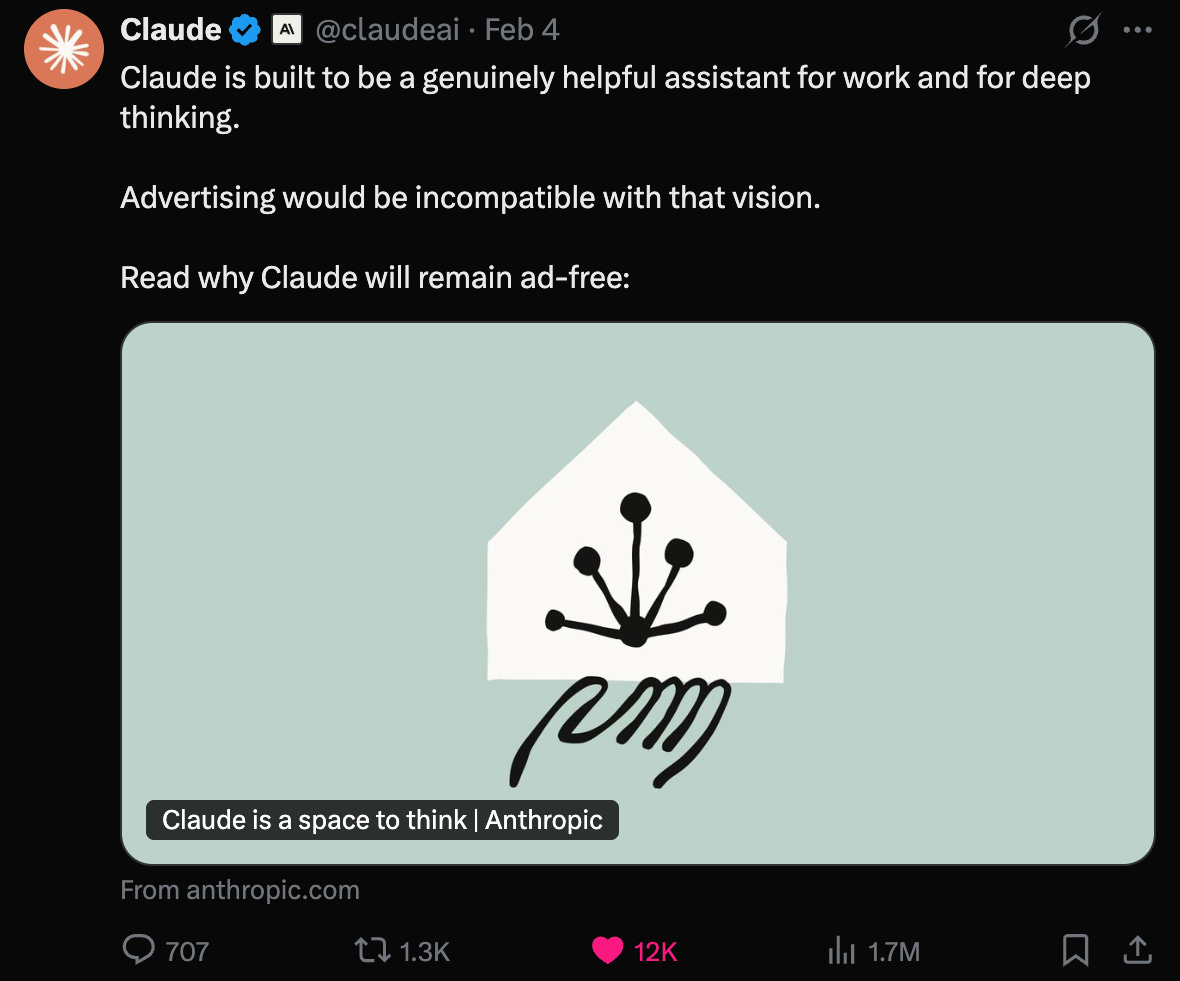
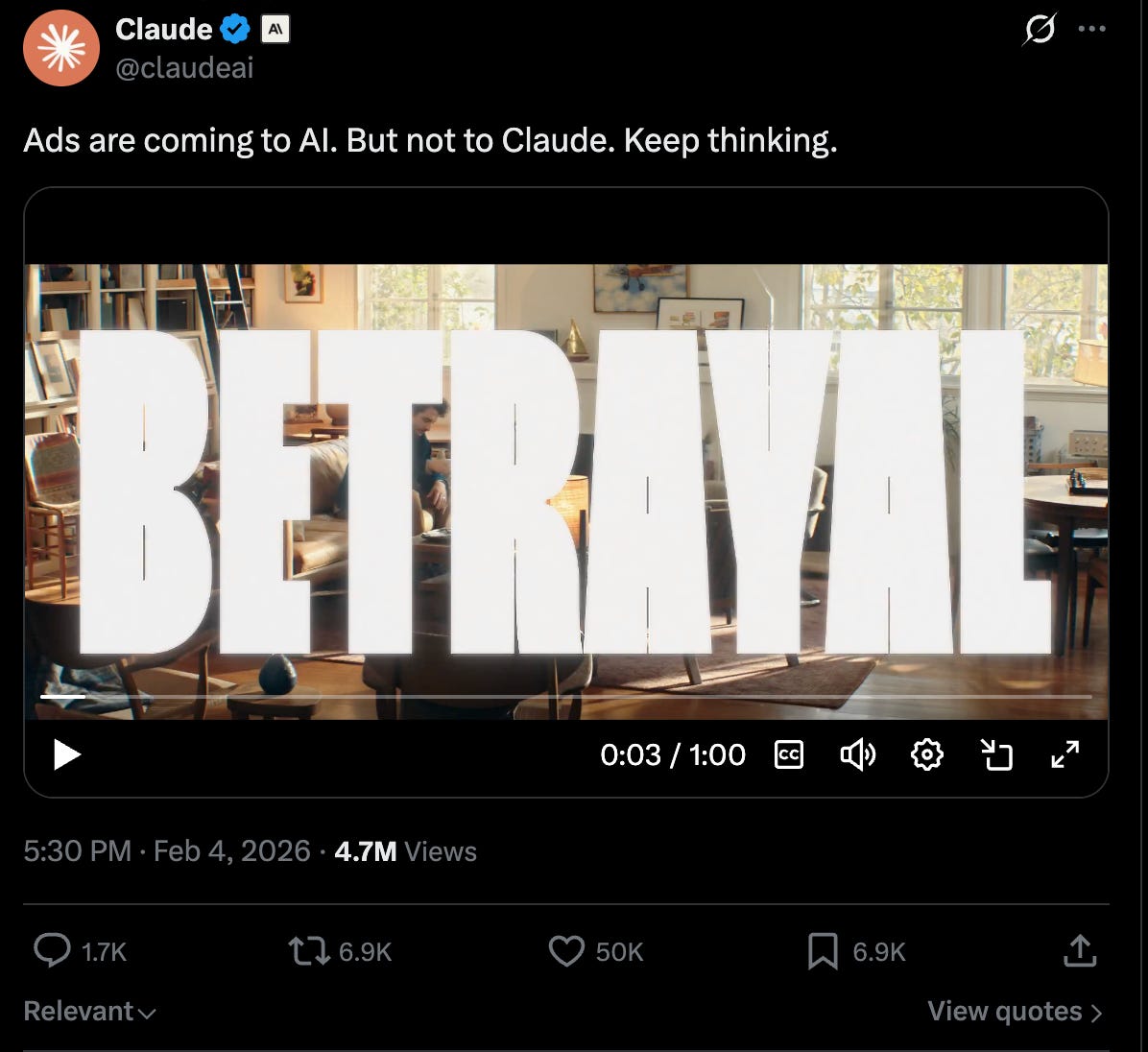
They also released a series of Super Bowl ads campaign that basically mocked OpenAI’s ad business (which was announced a few weeks prior). The ads went viral. The core message was that ads create bias, and Claude is the no-bias alternative. Which is a clever counter-position as the challenger in consumer AI.
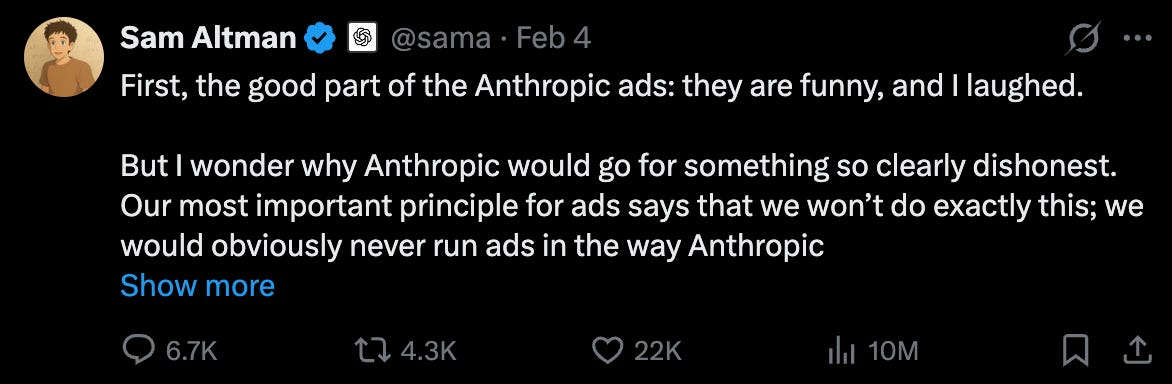
The ads did well enough to agitate Sam Altman, who responded that Anthropic was being dishonest - that ChatGPT had explicitly stated this won’t be the nature of their ads business. He has a point, but it seems all is fair in love, war, and the LLM wars.
2) The Blog Post: Explicitly Stating Commerce
In the blog post Claude is a space to think (brilliant marketing team) - they said it out loud. They’re going to support agentic commerce. Here’s the exact quote:
“AI will increasingly interact with commerce, and we look forward to supporting this in ways that help our users. We’re particularly interested in the potential of agentic commerce, where Claude acts on a user’s behalf to handle a purchase or booking end to end.”
They also stated:
“….interactions… will be grounded in the same overarching design principle: they should be initiated by the user (where the AI is working for them) rather than an advertiser….Today, whether someone asks Claude to research running shoes, compare mortgage rates, or recommend a restaurant for a special occasion, Claude’s only incentive is to give a helpful answer…”
They are clearly mentioning use cases like consumer research around running shoes!
Two things we can learn from this:
They’re coming strong into consumer.
They’re coming strong into agentic commerce - and positioning it as user-initiated, not advertiser-driven. It means the commerce layer is built around what the user asks for, not what a brand paid to surface (which might be more of a direction OpenAI is leaning into? we don’t really know yet as the ad business is not public yet). Whether that holds long-term is a different question, but for now they are trying to draw a clear philosophical line in the sand against OpenAI’s approach.
3) The Quiet One: MCP Apps Consolidating As The Standard
This one went under the radar, but we think it’s the biggest deal.
MCP Apps are consolidating as the standard across ChatGPT, Claude and VS Code . We’ve written a lot about MCP-UI standard in the past: the idea that the next “internet standard” is UI components rendered inside AI aapplications, not webpages rendered inside browsers.
And now there’s been real consolidation. On January 26, Anthropic and OpenAI jointly shipped MCP Apps as an official MCP extension - built on top of both MCP-UI and the OpenAI Apps SDK. What used to be “ChatGPT Apps” is now framed as MCP Apps. OpenAI’s own docs literally have a page called “MCP Apps compatibility in ChatGPT.” That’s a meaningful shift in positioning.
And if you go to Claude’s Connect experience, it’s pretty obvious they’ve been cooking. The MCP app experience there is genuinely impressive.
We tried running Excalidraw MCP and gave it this prompt:
“Research and compare the major Agentic Commerce standards (ACP and UCP), then summarize them in a single excalidraw diagram and a concise written explanation.”
Here are the results -
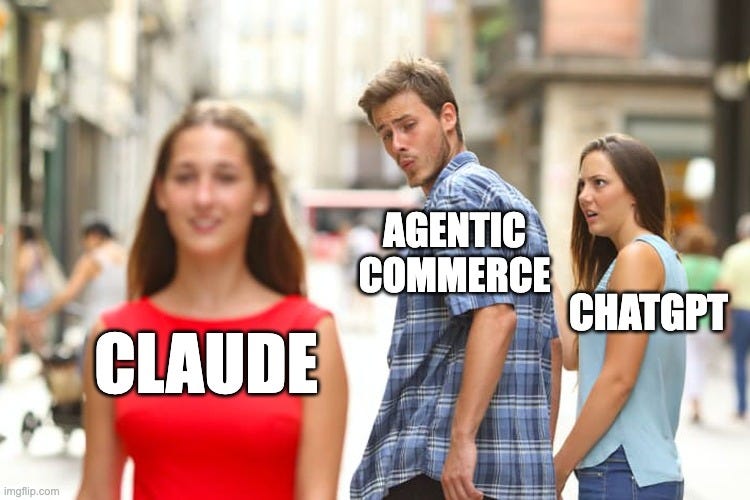
Which makes you think: they’re very close to embedding commerce directly into the Claude app. The infrastructure is there, the app layer is there and the ad-free positioning is there. Now it’s just a matter of plugging in checkout.
But which checkout? That’s the billion-dollar question.
They could go with OpenAI’s ACP - which doesn’t have real distribution yet. Or Google’s UCP - which isn’t fully live but probably has the best shot in terms of distribution. And then there’s the positioning problem: Anthropic just counter-positioned against OpenAI in front of the entire world. Adopting their commerce protocol would be… awkward.
The checkout component for Claude is going to be one of the most interesting things to watch in the next few months. But one thing is for sure - we just got another horse in the agentic commerce race!
Thanks for reading! If you want to read more strategic analysis on the edge of agentic commerce, subscribe below:
Commerce is actually a terrible use case for agents. It's high-stakes (money involved), customer-facing (reputation risk), and full of edge cases (returns, disputes, international shipping). Most commerce companies can't even get basic inventory management right - adding agents into that mix seems premature. Focus on internal workflows first, customer-facing later.