
🚨 Breaking 🚨 Google added a new “Agentic Browsing” category to Lighthouse.
And yes - it checks whether your site supports WebMCP.

We’re one week out from Google I/O. Big announcements are expected around Chrome and agentic commerce - and just ahead of the event, we caught an interesting change to Lighthouse in the wild that probably hints at what’s coming to Chrome and the agentic web.
What is Lighthouse
If you’ve ever built or optimized a website, you know Lighthouse. It’s Google’s open-source auditing tool - the one that scores your site 0-100 on performance, accessibility, SEO, and best practices. Every web team in the world runs it. It is effectively the universal yardstick for “is this website any good.”
A week ago Lighthouse added a new category: Agentic Browsing.
What it does in plain terms: instead of measuring whether humans can use your site, Agentic Browsing measures whether AI agents can (specifically agents that operate a browser, like Gemini in Chrome that we’ve written about).
When you go into the Lighthouse website, you can see a new tab for “Agentic Browsing Audit”:
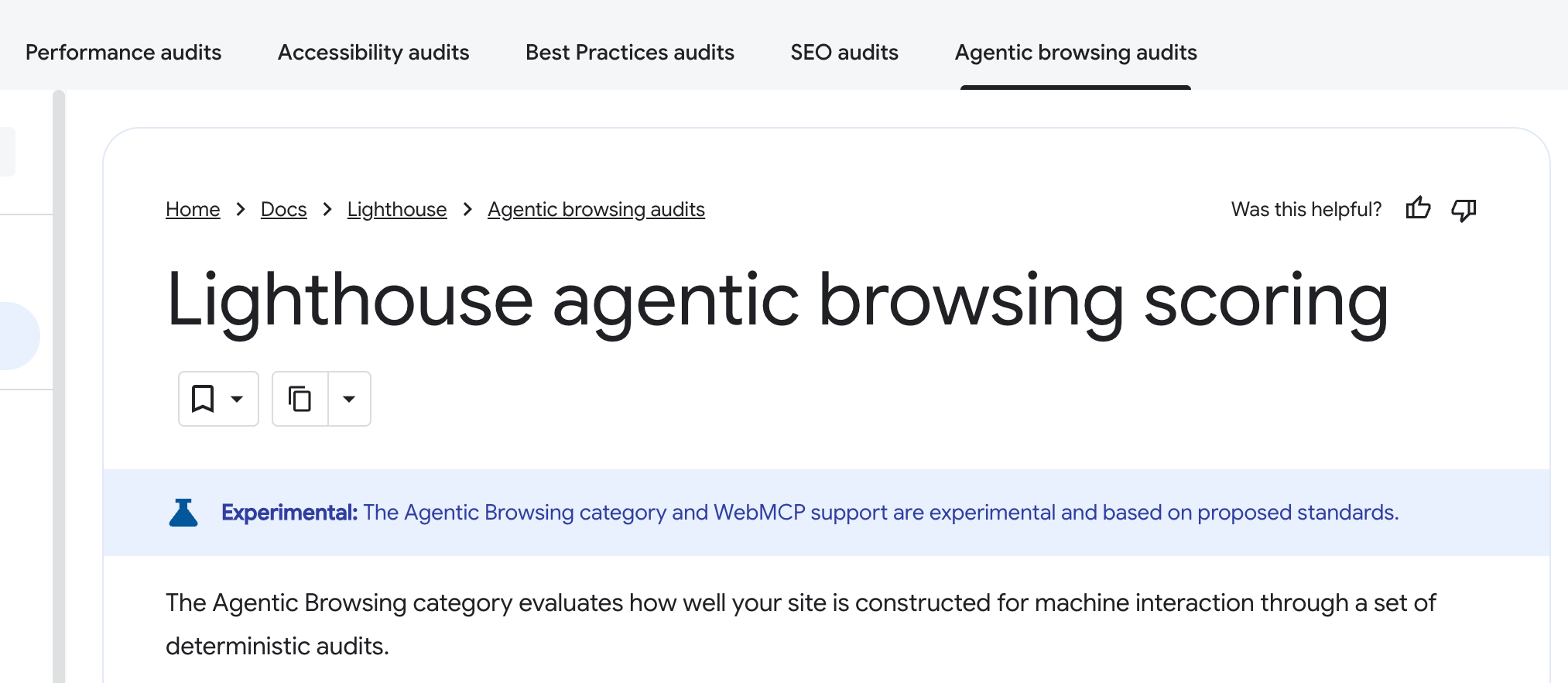
What it actually audits
The audit checks 3 things:
WebMCP implementation: we have written a lot about WebMCP and its importance. This check verifies that your site exposes tools and actions for agents using the proposed WebMCP standard - are tools registered correctly? Do their schemas validate? Do they cover the forms on your page?
llms.txt: do you have one, and is it valid?
Agent accessibility: this checks accessibility basics. Are your buttons and form fields properly labeled? Do interactive elements have the right roles and structure? This aims to make it easier for agents to interact with websites.
Google’s guidance for anyone who wants to make their site agent-ready: adopt WebMCP, clean up your accessibility tree, and stabilize your layout.
The Lighthouse website also has a complete section about WebMCP best practices.
A few interesting things to think about -
Will Google announce GA support for WebMCP in Chrome at I/O? It’s currently in preview mode, so you need to flip a switch in the browser for it to work (mostly developers do this). Plus WebMCP is still not live in Gemini in Chrome. So right now it only works if you have some chat extension that supports WebMCP and the browser “WebMCP mode” is turned on.
llms.txt is back? llms.txt is a standard notoriously known for being ignored - by crawlers, by agentic browsers, by pretty much every AI agent on the planet. Could Google be trying to push it back into the picture? We also caught some recent work on llms.txt inside the Universal Commerce Protocol (also authored by Google). Taken together, these small signals might mean Google is trying to make llms.txt actually useful as a way for sites to communicate with agents.
We’re excited to see what actually ships next week in Google I/O - across both Chrome and Gemini. But one thing is already clear: the browser is morphing into something new, and every website will need to rethink a lot - infra, consumer journeys, analytics, funnels.
If you want to learn more about implementing WebMCP, reach out at founders@nekuda.ai. And subscribe below for more agentic commerce news.