
👻 Agentic Commerce Ghosts are Currently Traveling Through Your Website
Welcome to a hybrid agentic commerce future — where consumers visit your site, but bring their own agent along for the ride.

TL;DR
AI assistants like Gemini in Chrome are now sitting alongside users on your website, answering their questions, comparing you to competitors, and shaping conversion decisions — all invisibly.
We call it Dark On-Site AI Activity (DOSA). It’s likely happening on your site right now, and there’s currently no way to see it.
The AI hype said UI and websites are dead. But what’s actually happening is different and more nuanced: humans keep browsing, but with an AI co-pilot. So they experience the web in a hybrid way. Your site still matters — but the journey running through it is being rewritten using AI.
There’s a lot you can do about it — but like any problem, the first step is recognition. Read our thoughts below.
There’s a recent term RefiBuy has coined called Dark Agentic Commerce Traffic — high-intent traffic driven to your site by AI applications (ChatGPT, Claude, Gemini, Google’s AI Mode, etc.). According to recent studies, this traffic converts exceptionally well (4x compared to average traffic) and is hard to attribute (only 1/3 is correctly attributed to AI), which creates a real sourcing problem.
But the darkness doesn’t end there. There’s a closely related problem we’ve been seeing downstream of Dark Agentic Commerce Traffic, which we call Dark On-Site AI Activity — or DOSA for short.
DOSA happens when users are browsing your website but using AI tools as intermediaries. For example, they open the Gemini side panel and ask questions directly about your site, or they use Google’s new AI Mode browsing (which we described in a recent blogpost), which opens a browsing session inside an AI interface.
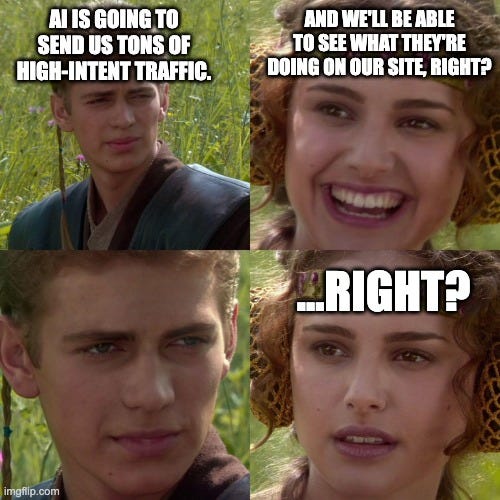
This creates a hybrid experience for consumers: they can see your website, but they can also ask the side panel AI questions about pricing, features, comparisons, and more. Unfortunately for site owners, there’s currently no way to know users are engaging in this behavior or what they’re actually asking. (SEO folks have found some clever ways to identify a small portion of AI Mode browsing activity, but it only works for a fraction of traffic — and even then, it provides only attribution data, not the actual questions being asked.)
Check out this quick demo when we use Gemini in Chrome to navigate Adidas website:
The way this technically works is that when the website loads, Gemini pulls the site in as context (without notifying the website owner) and essentially is becomes the context for the user’s Gemini queries.
Because of Chrome’s massive distribution (>3.5 billion users worldwide, with 85% market share on desktop), combined with the recent release of Gemini in Chrome, this activity is likely already happening on most websites. Users are asking questions, comparing to competitors, and making decisions with the help of these assistants — all invisible to the website owner.
We find a great walkthrough video of the new AI Mode browsing experience, which is similar to Gemini in Chrome by Lily Ray here.
BYOA - Bring Your Own Agent
Early in the LLM revolution, there were plenty of “spicy” takes about how UI is dead, your website is dead, and everything will be consumed by agents. The road we’re actually heading down looks very different, most of the visuals and interfaces we’ve built remain relevant, but users now have an AI companion following them around — whether that’s in the browser or using the AI apps themselves.This makes sense when you consider that humans still need visual interfaces — especially in commerce. Three decades of web development aren't going away, and the benefits that medium has built up remain very much intact.
In other words, most future traffic landing on your site will still be human — just with a co-pilot. This isn’t the fully autonomous AGI future the hype promised (maybe some version of this very autonomous future is happening in coding which represents a separate frontier).
Important to note, that although ,any websites have spent much resources in building their own agents, Users don’t necessarily rely on the agent the site owner is bringing (e.g., Amazon’s Rufus or Walmart’s Sparky) — they Bring Their Own Agent.
The good news: these assistants genuinely help consumers make better choices, convert faster, and find information more easily. The bad news: they reshape consumer journeys, and those assistants are working for users and not website owners. Your polished consumer journey via the website will need to accommodate for this. Users who used to convert on your site may spill over elsewhere, and vice versa.
Understanding how these tools intermediate your site — and how that changes the user journey — will be critical, especially as AI adoption is now measured in billions of users.
What can you do about it
A great starting point is Google’s recent “Build agent-friendly websites” guidance. We are also providing visibility service for websites by reviewing how Gemini in Chrome represents their site, you can get a free sample report here.
Another direction is WebMCP, which we’ve been writing about a lot— and which we believe will be a game-changer for site owner visibility and consumer UX. In short, it lets websites expose tools directly in the page, so AI assistants like Gemini interact with those tools rather than scraping the site blindly. The site owner sees the tool calls and can understand the user journey. You can read more about it here, or schedule a call if you’d like to learn more.
We’ll be writing much more about these topics this year. If you’re interested in agentic commerce, new internet consumer journeys, and how AI is changing how people buy online — subscribe below, and feel free to share with friends and colleagues.