
Agentic Commerce Gatekeeping Problem
You either die a platform, or live long enough to see yourself become the aggregator.

TL;DR

Agentic commerce protocols are evolving differently from classic internet standards - they launch as “open,” but with commercial partners controlling distribution from day one.

Platforms like Shopify are becoming aggregators - they sit in the middle early, gaining first access to merchant adoption, traffic, and protocol influence.

This creates a data asymmetry: Shopify can see cross-merchant performance patterns, while each merchant only sees their own sales.

Over time, there will be a key risk to merchants - platform’s rational incentive shifts toward optimizing aggregate GMV, not individual merchant. Which might conflict with individual merchants interests.

Merchants will need to join these AI surfaces, but should be careful not to give up control of their catalog, checkout and data to aggregators. Own your catalog and checkout so you can connect to any AI surface without being locked into one intermediary.

The good news is that AI tools are democratizing software - meaning more merchants can now build or buy neutral infrastructure, own their stack, and plug into any agentic surface without being fully dependent on an aggregator.
The way agentic commerce protocols are evolving is very different from how traditional internet protocols evolved through internet history. TCP/IP (the core protocol powering internet communications) had committees, RFCs, years of deliberation. Open standards used to be “democratic” and developed in the open. But in the AI scene today, protocols evolve very differently.
Both OpenAI’s Agentic Commerce Protocol (ACP) and Google’s Universal Commerce Protocol (UCP) came out of the gate with an ecosystem of partners adopting them from day one. OpenAI built ACP with Stripe. Google built UCP with Shopify. Both launched with merchant partners already onboarded and distribution already secured.
We like to call this strategy: “open source, but I go first.”
These are essentially open protocols that are commercial from day one, and the commerce and payment partners co-authoring them have a significant advantage: they get first access to distribution. Both ACP and UCP remain in closed beta - if you want in, you need to go through the distribution partners. These partners can also shape the protocols in ways that benefit them commercially from the outset. (To be clear: we actually admire the companies mentioned here and their leadership in agentic commerce. But it’s important to highlight this dynamic.)
Shopify has very intelligently positioned itself in the middle of both protocols, offering from day one a product suite that includes catalog optimization for agentic commerce channels and the checkout component to sell on them. This is now initially rolling out on ChatGPT.
They have a big network of merchants who mostly see Shopify as a tech platform that replaces building their own commerce and payment stack. This is part of Shopify’s core DNA - historically positioning itself as the anti-Amazon. “Arming the rebels,” as Tobi Lütke liked to say. The company that gave small merchants a way to own their store and their future.
The challenge is that in using these pipes to sell on AI surfaces, merchants are sharing substantial business data - data that will become increasingly valuable as agentic commerce matures. By aggregating many merchants and retailers into a single interface, AI surfaces like ChatGPT, Gemini, and other agents operate very differently from traditional channels. Merchants who rely too heavily on intermediaries for their relationship with AI surfaces may find themselves at a disadvantage over time.
The Data Layer Problem
A quick refresher on how Shopify makes money: a decade ago, most of Shopify’s revenue came from SaaS subscriptions. Today, most comes from payment processing -meaning they earn more when merchants earn more, as their revenue correlates directly with underlying GMV. This creates strong alignment: when merchants grow, Shopify benefits.
But here’s where it gets complicated.
When Shopify deploys a merchant catalog on an AI surface - let’s say ChatGPT -here’s what Shopify knows:
Which merchants drive volume
Which products convert
Which data structures perform best
Category benchmarks across their entire merchant base
Price elasticity curves
Seasonal patterns
What individual merchants know: their own sales data. That’s essentially it.
What no one can see: how the AI ranking actually works, whether their products are being surfaced, or why they might be getting deprioritized.
This dynamic is new because, for the first time, Shopify is directly involved in the data layer that determines what gets discovered on AI surfaces. If product discovery on ChatGPT and Gemini depends heavily on merchant catalogs, then Shopify becomes the system sitting on top of the most critical inputs: titles, descriptions, attributes, pricing, inventory, and conversion outcomes.
From an aggregator optimization perspective, the “rational” move over time is straightforward: rank and surface the products most likely to convert, because that maximizes GMV - and maximizing GMV maximizes Shopify’s revenue.
This is still very early to know how it will play out, but there are many ways an aggregator can influence merchant success: by controlling catalog optimizations, deciding what real-time insights to share (and what to keep internal), and making changes on merchants’ behalf based on patterns only visible at the platform level.
If Shopify controls both the catalog layer and the performance layer, the math naturally shifts toward optimizing GMV at the platform level - not at the individual merchant level. Any player that eventually sits on both the data layer and the distribution layer faces this same tension. The incentives pull toward aggregate optimization, not individual merchant success. In economics, this is usually referred to as the classical principal-agent problem.
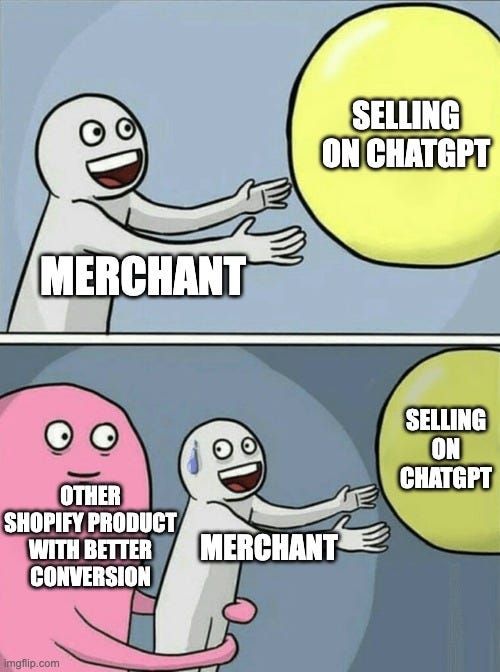
The Evidence: Changes to Shopify’s Terms
The pattern is already visible in Shopify’s recent terms changes.
First came Shopify Network Intelligence in July 2025, which aggregates customer data across all merchants to power “Enhanced Services.” If merchants disable it, they lose access to Shopify Audiences, Shop channel, Shopify Email, Shopify Collabs, and Shopify Search & Discovery. Shopify explicitly states: “In the future, Shopify may expand the list of apps and features that require Shopify Network Intelligence to be enabled.” (source)
Then came Agentic Storefronts in January 2026. Merchants were auto-opted into selling through ChatGPT, Google AI Mode, and Microsoft Copilot - with new fees layered on top of existing subscription and transaction costs. The terms are: AI partners can override your checkout branding and customizations; your upsells, loyalty widgets, and abandoned cart automations may not fire; you remain fully liable for disputes even if the AI misrepresents your product; and opting out of checkout doesn’t mean opting out of visibility. Perhaps most telling: Shopify can add new AI partners at any time, and your continued use automatically constitutes acceptance of their terms. As Tobi Lütke put it: “We’re making every Shopify store agent-ready by default.” (source)
The pattern is clear: data sharing is becoming mandatory, and the list of features that require it keeps growing.
The Aggregator Creep
Some moves in recent years have made Shopify look more like an aggregator than a platform. Take Shop App, for example - an Amazon-like marketplace built on top of Shopify that aggregates products from across the Shopify network. Within Shop App, one merchant might compete with another for visibility, and suddenly Shopify feels a bit more like Amazon.
This is a familiar pattern: any platform can eventually start behaving like an aggregator. It’s the natural cycle of technology businesses. To be fair, Shop App has historically been fairly harmless, generating less than 1% of total Shopify volume. But Shopify’s recent all-in bet on AI distribution channels could prove far more consequential.

This dynamic isn't unique to Shopify. We've been hearing similar concerns from merchants approached by payment processors and adjacent commerce vendors-companies like PayPal and others who traditionally had limited visibility into merchant operations beyond the transaction. Now, through the pitch of "we'll onboard you to agentic commerce," they're requesting detailed catalog and SKU-level data from every merchant they bring on. The risk is the same: being aggregated alongside your competitors, or getting locked into a service that's hard to leave. The gatekeeping pattern is emerging across the stack - not just in platforms, but in payments too.
What This Means for Merchants
So where does this leave merchants?
We’re not saying merchants should avoid these platforms - they’ve benefited e-commerce and the internet significantly. Merchants who don’t participate risk becoming invisible on the fastest-growing acquisition channels. These platforms offer tremendous value, especially if you don’t have the development resources or the budget.
But merchants should understand the game being played.
The play for large commerce and payment platforms is to become big enough to sit on all the traffic, then aggregate it and extract business value. That’s what aggregators do - it’s just the rational play. Traditionally, small merchants didn’t have many options. But AI tooling is democratizing access to software, and you can gradually take more control of your stack.
The question for merchants is: how do you participate in agentic commerce while maintaining sovereignty over your customer relationships, your data, and your brand?
Some things to consider:
If you’re big enough, build or buy something neutral. Don’t rely entirely on infrastructure controlled by companies whose incentives may diverge from yours. For mid-market and enterprise brands, the strategic move is clear: own your catalog and your checkout layer. The catalog is the heart of agentic commerce - it’s how AI surfaces understand your products, your brand, and your value proposition. Whoever controls your catalog controls how you’re represented. The checkout is the last mile - it’s where the transaction happens, where the customer relationship is cemented, and where the most valuable conversion data lives. If you outsource either to an aggregator, you’re handing over the keys to your most defensible assets. The brands that will thrive in agentic commerce are the ones who own both layers - and can plug into any AI surface without an intermediary deciding how they show up, what fees they pay, or what data they share.
Understand what data you’re giving away - and to whom. Cross-merchant visibility is extremely valuable, and you may be providing it for free.
Watch for signs of aggregator behavior. Product networks that cross-sell competitors’ products. Ranking systems you can’t see or influence. Fees that increase once you’re locked in.
Thanks for reading! If you want to read more strategic analysis on the edge of agentic commerce, subscribe below:
If you’d like to consult on how to build out your agentic commerce stack, maintain sovereignty, and avoid disintermediation risks, feel free to reach out at founders@nekuda.ai.
The asymmetry point is the killer insight here. Shopify sees cross-merchant patterns while individual merchants see only their own data. That's not a neutral platform - that's an intelligence advantage.
'Open source, but I go first' perfectly describes what's happening with both ACP and UCP. The committees are theater. The protocols ship with commercial partners pre-integrated.
What concerns me most: merchants optimizing for AI discovery might end up in the same trap as SEO. Chase the algorithm, lose your brand. At least with human customers you could build emotional connection. Agents don't have brand loyalty.
This is one of the sharpest takes on agentic commerce I've read. The platform gatekeeping angle deserves way more attention than it's getting.
Really liked this - especially the point about early protocol control creating asymmetric visibility. That part matters more than most people realise.
From the merchant/product side, I keep coming back to a simple question: when agents start transacting against your stack, who’s actually making the call - your rules or the platform’s defaults? And who owns the data exhaust from that interaction?
Those two often get blurred, and that’s where “autonomy” starts meaning different things depending on where you sit.
Curious how you think about separating merchant-governed decisioning from platform-level optimisation in these systems.